
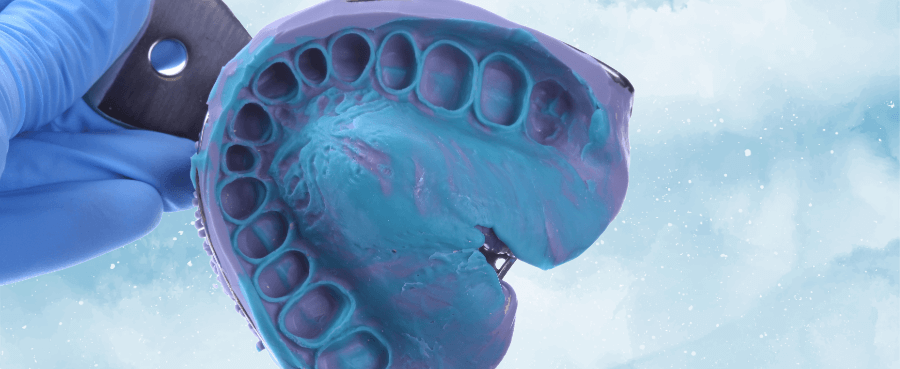
In the world of dentistry, the ability to take a precise dental impression is a fundamental skill that directly influences the success of various dental procedures.
Whether creating restorations, crowns, bridges, or custom appliances, a flawless dental impression lays the groundwork for a successful treatment outcome. The dental impressions serve as a replica of the patient’s oral structure. It captures unique contours of teeth, gums surrounding tissue providing a crucial blueprint for the lab to work with and follow.
Achieving accuracy in the impression process is paramount for ensuring a comfortable fit, proper function, occlusion, and natural aesthetic.
These three materials are the most widely used. Alginate is a widely used material for preliminary impressions due to its cost-effectiveness and ease of use. However, it is crucial to work quickly, as alginate sets rapidly, and any delays can result in inaccuracies. Polyether offers excellent dimensional stability and is known for its accuracy. This is often used for final impressions when precision is paramount. It has a relatively short setting time and provides detailed reproductions of the tooth and tissue structure. Dental impressions using intraoral scanners, the goal is to clearly see the margin and keep the area dry from blood and other debris. Intraoral scanners that take digital impressions have gained popularity for their speed, comfort, and accuracy. These devices use advanced technology to create a 3D model of the oral structures. Digital impressions also offer the advantage of easy storage and transfer of data.
The most important aspects of impressions are technique, moisture control, tray selection, mixing and loading, and patient cooperation.
Saliva and blood can compromise the accuracy of impressions. Proper isolation with rubber dams or cotton rolls ensures a dry field, enhancing the precision of the impression.
Choosing the right tray size and design is crucial. The tray should adequately cover all the teeth without impinging on the soft tissue. A custom tray may be used for specific cases to improve accuracy.
Accurate mixing of impression material and prompt loading into the tray are essential. Follow the manufacturer’s instructions meticulously to achieve the correct consistency and working time.
Clear communication with the patient is vital. Instructing them to remain still, breathe regularly, and avoid excessive movements ensures a successful impression.
Quality control is a key component to making a great impression. After taking the impressions, you should inspect it for any distortions, voids, or tears. A high-quality impression serves the foundation for creating precise dental restorations. Don’t cut corners on this process and send the lab an impression that does not meet the above standards as this can only cause a delay in the case or a potential remake. If you inspect the impression while the patient is still there, and need to take another impression, this will be better than the lab requesting a new one and having to get the patient in all over again.
Mastering the art of taking the perfect impression is a cornerstone of delivering exceptional restoration to your patients. Whether using traditional PVS impressions or intraoral impressions the commitment to precision, technique, and attention to detail remains paramount. A meticulous approach to dental impressions not only enhances the quality of restorations but also will reduce your remakes and in turn provide the patients with the best care.
Contact us if you have questions about making a great impression, or any of our services. We are here to help.